
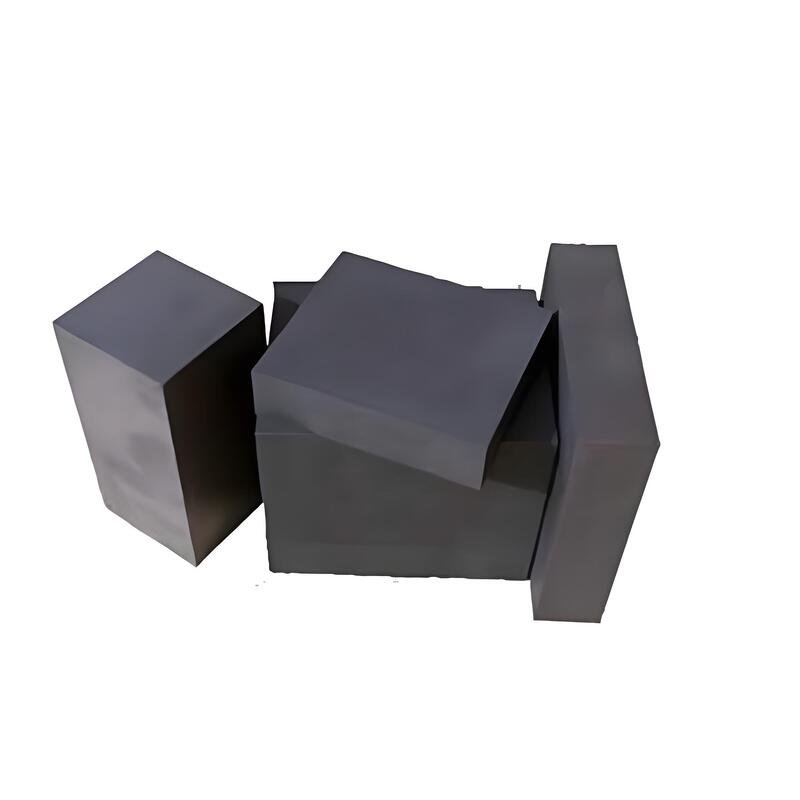
Due to their excellent resistance to slag erosion and thermal shock, graphite-containing unshaped refractories have emerged as ideal candidates for ladle linings in secondary steelmaking processes. One challenge in preparing graphite-containing unshaped refractories is graphite’s poor wettability with water. To achieve the same workability as traditional unshaped refractories, more water must be added during mixing. However, this excess water increases the porosity of the refractory after drying, adversely affecting the mechanical properties of the final product. Japanese researchers investigated methods to reduce the interfacial tension between graphite and water and systematically studied the effects of selected graphite dosage on the mechanical properties, slag resistance, and thermal shock resistance of aluminum-magnesium-carbon unshaped refractories.
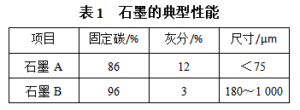
First, the effect of surface modification on the wettability of two types of flake graphite (with typical properties shown in Table 1) was investigated. Graphite surfaces were modified using oxygen plasma treatment and sol-gel coating techniques. Oxygen plasma treatment: 250 g of flake graphite was treated with oxygen plasma for 20 min to activate the surface and enhance wettability by increasing the concentration of hydrophilic functional groups (carboxyl, carbonyl, epoxide groups, etc.) on the graphite surface. Sol-gel coating treatment: Graphite was thoroughly mixed with diluted hydrophilic nano-alumina sol (AS-200, ϕ 5–7 nm, pH 4–6, solid content 10%). The mixture was then placed in a vacuum chamber for 15 min to promote sol penetration and eliminate bubbles, followed by drying at 110 °C for 3 h to form a uniform and stable coating.
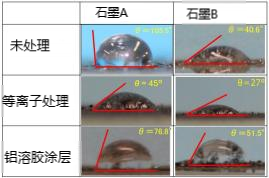
Study of Graphite Wettability: The contact angle between a 2 μL droplet of distilled water and the graphite surface fixed on a glass substrate was measured. To analyze the reasons for the differences in graphite wettability, XPS and SEM were used to examine the bonding state and micro-morphological features of the graphite surface, respectively. The contact angle measurements of graphite (as shown in Figure 1) indicate that Graphite B exhibits a smaller contact angle with water than Graphite A, demonstrating superior water wettability. The contact angles of both graphite types significantly decreased after plasma treatment, indicating a marked improvement in wettability.
SEM images of graphite microstructure reveal that Graphite A primarily consists of flake-like particles; Graphite B exhibits a mixed morphology of flake-like and columnar particles, with an average particle size larger than that of Graphite A. The columnar structure and larger particle size of Graphite B suggest a higher concentration of active sites or hydrophilic functional groups, resulting in superior hydrophilicity. To further investigate the surface chemistry of graphite, XPS analysis was performed on untreated Graphite A and plasma-treated Graphite A. Results revealed a slight increase in the relative abundance of hydrophilic oxygen-containing groups (C-O, C=O, C-OH) after plasma treatment, while the amounts of C=C and C-C functional groups remained largely unchanged. This indicates that plasma treatment enhances the wettability of graphite. Considering the balance between performance and processing cost, untreated Graphite B was selected as the carbon source for further studies on aluminum-magnesium-carbon refractory materials.
Aluminum-magnesium-carbon unshaped refractory specimens were prepared according to Table 2. After mixing the raw materials according to the specified ratio, part of the mixture was used to determine the flow characteristics of the castable, while the remaining portion was poured into designated molds to form specimens measuring 40 mm × 40 mm × 160 mm. These specimens were demolded after curing at 20°C for 24 hours. After drying, the cast specimens were subjected to heat treatment at 1400°C with buried coke for 3 hours. The apparent porosity and elastic modulus of the heat-treated specimens were measured. Resistivity to slag attack test: Specimens heat-treated (1400°C, 3 h soak, buried in coke) underwent a 1-hour rotating slag erosion test at 1650°C using a prepared representative steelmaking slag (CaO/SiO₂ = 4.2, T.Fe content 17.4%). Thermal shock resistance test: Heat the specimen to 1400°C and hold for 15 min, then water-cool for 10 min. Measure the dynamic elastic modulus before (E0) and after (E1) thermal shock, using the ratio E1/E0 as an indicator of thermal shock resistance.
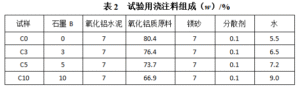
Test results indicate that as graphite content increases, the fluidity of the castable decreases, the apparent porosity of the specimens rises, and the elastic modulus decreases. Rotating slag erosion resistance test results show that the slag adhesion layer thickness of specimens with added graphite is less than that of specimens without graphite, indicating that adding graphite can improve slag erosion resistance. The thickness of the adhered layer was nearly identical across different graphite contents. However, slag penetration depth increased with rising graphite content. This was attributed to the higher apparent porosity caused by increased water demand in the castable as graphite content rose. Thermal shock resistance tests revealed enhanced thermal shock resistance with increased graphite addition. Although graphite addition reduced the mechanical strength of the specimens, it improved their overall thermal conductivity and thermal shock resistance.
Based on the above research findings, Graphite B exhibits superior wettability compared to Graphite A. When added to aluminum-carbon-carbon castables, increasing the graphite content requires additional water to achieve the desired fluidity, leading to an increase in apparent porosity. Furthermore, as graphite content rises, the elastic modulus decreases while thermal shock resistance improves.