
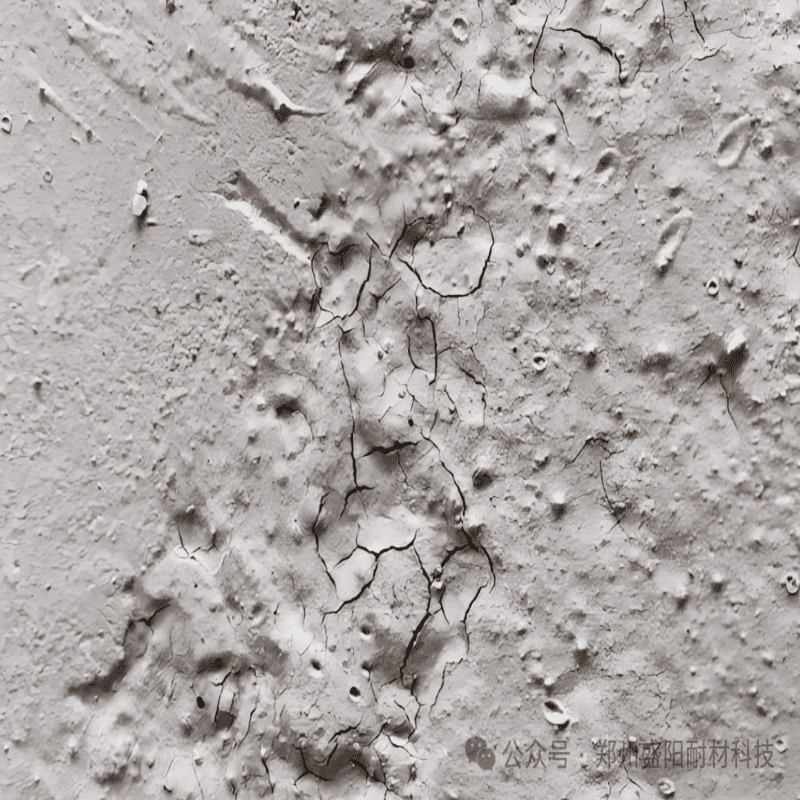
The problem of refractory castable cracking is complex, but it is closely related to many factors, including production processes, raw materials, binders, and, most importantly, the baking rate.
Currently, the matrix of refractory castables in China is mainly composed of SiO2 and Al2O3 raw materials, and the binder is primarily aluminate cement, a fast-hardening, early-strength type. Therefore, sufficient curing time and a reasonable baking regime are required after construction.
To address the cracking problem of refractory castables, the first step is to add 0.1%-0.3% organic explosion-proof fibers to the production process. This is because the explosion-proof fibers melt at 160℃ and form a penetrating structure that can be evenly distributed in the fine, narrow pores of the castable. This increases the permeability of the castable, accelerates venting, and buffers water vapor pressure, preventing cracking caused by baking and rapid temperature changes.
Another cause of refractory castable cracking is that during the baking stage, due to excessively rapid heating, the free water within the castable changes from liquid to gas in a short time. As the baking temperature rises, a certain vapor pressure is formed. When the water vapor inside the castable cannot diffuse and escape in time, the pressure within the material increases. When the internal water vapor pressure becomes unbalanced, spalling, peeling, and cracking of the refractory castable occur.
Additionally, it is crucial to leave ventilation holes during construction to prevent cracking. Ideally, use 3mm diameter bamboo sticks to create venting holes, with 100 holes per square meter. Furthermore, during baking, the temperature should not rise too quickly; for temperatures below 150℃, the heating rate should not exceed 10℃, and for temperatures below 350℃, the longer the heating time, the better.